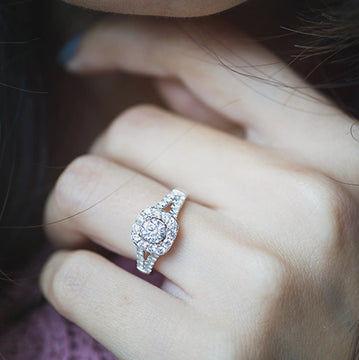

Understand 4 Cs of Diamonds
Understand the 4 Cs of Diamonds
Choosing a diamond is both an emotional and informed decision. Whether you are selecting an engagement ring, commemorating a milestone, or investing in a timeless piece of fine jewelry, understanding diamond quality is essential. The 4 Cs of Diamonds (Cut, Clarity, Color, and Carat) serve as the universal standard for evaluating a diamond’s beauty, value, and overall character.
At Rodgers Diamonds, we believe that confidence comes from knowledge. When you understand how each of the 4 Cs influences a diamond’s appearance and performance, you are better equipped to choose a stone that reflects your style, priorities, and story.

What Are the 4 Cs of Diamonds and Why Do They Matter?
The 4 Cs of Diamonds are a globally recognized grading system developed to provide consistency and transparency in diamond evaluation. Each “C” represents a specific quality factor, and together they determine how a diamond looks, sparkles, and holds its value over time.
Rather than ranking one factor above another, the most beautiful diamonds strike a thoughtful balance across all four. Understanding how they interact allows you to prioritize what matters most, whether that is brilliance, size, rarity, or purity.
For a deeper look at how these elements come together in engagement jewelry, explore Rodgers Diamonds’ detailed guide on how to choose a diamond for an engagement ring.
Diamond Cut: The Key to Brilliance
Diamond cut is often considered the most important of the 4 Cs because it directly affects how a diamond interacts with light. Cut refers not to the shape of the diamond, but to the precision of its proportions, symmetry, and facet alignment.
A well-cut diamond reflects light internally and disperses it through the top of the stone, creating brilliance, fire, and scintillation. Even a diamond with excellent color and clarity can appear dull if the cut is poor, while a well-cut diamond can appear more vibrant and lively regardless of size.
Popular diamond cuts include round brilliant, princess, oval, cushion, emerald, and pear, all of which can be used in various types of jewelry such as necklaces, rings, and earrings.
Diamond Clarity: Understanding Natural Characteristics
Diamond clarity measures the presence of internal inclusions and external blemishes formed during the diamond’s natural creation. Because diamonds are formed under extreme pressure and heat, most contain small characteristics that make each stone unique.
Clarity grades range from Flawless to Included. Many inclusions are microscopic and invisible to the naked eye, meaning a diamond can appear perfectly clear without being technically flawless. Choosing a diamond that is “eye-clean” often allows for excellent value without compromising beauty.
Clarity becomes especially important in larger diamonds or certain cuts that emphasize transparency. Understanding how clarity impacts appearance helps ensure your diamond looks stunning in real-world wear.
Diamond Color: Subtle Differences, Lasting Impact
Diamond color refers to how much natural color is present within a white diamond. Graded on a scale from D (colorless) to Z (light yellow or brown), even slight variations can influence both appearance and price.
Colorless diamonds reflect light more purely, creating a crisp, bright look. Near-colorless diamonds, however, often appear just as white once set in jewelry, especially when paired with yellow or rose gold.
The ideal color choice depends on personal preference, setting style, and budget. Understanding how metal choice and cut affect color visibility allows you to select a diamond that appears beautifully balanced in its final design.
Diamond Carat: Size and Visual Presence
Carat measures a diamond’s weight, not its physical size, though the two are closely related. Larger carat diamonds are rarer and often more valuable, but carat alone does not determine beauty.
Two diamonds of equal carat weight can look dramatically different depending on cut quality and proportions. A well-cut diamond may appear larger than a poorly cut stone of the same carat weight.
Understanding carats also involves knowing the difference between carats and points. One carat equals 100 points, a distinction often used when describing smaller diamonds or accent stones.

How Fluorescence Affects a Diamond
Fluorescence refers to a diamond’s tendency to emit a soft glow under ultraviolet light. While often misunderstood, fluorescence does not automatically diminish a diamond’s beauty.
In many cases, fluorescence has no visible effect in everyday lighting. In some higher-color diamonds, faint fluorescence can even enhance brightness. Only in rare cases does strong fluorescence create a cloudy appearance.
Evaluating fluorescence alongside the other 4 Cs ensures a complete understanding of a diamond’s characteristics.
Natural vs. Lab-Grown Diamonds
Both natural and lab-grown diamonds are real diamonds with identical physical and chemical properties. The primary difference lies in origin. Natural diamonds are formed over billions of years within the Earth, while lab-grown diamonds are created using advanced technology in controlled environments.
Natural diamonds carry rarity and tradition, often associated with long-term value and legacy. Lab-grown diamonds typically offer a larger size or higher clarity at a lower price point. The right choice depends on personal values, budget, and long-term goals.
Choosing Your Diamond with Confidence
Understanding the 4 Cs of Diamonds transforms the shopping process from overwhelming to empowering. When you know how cut, clarity, color, and carat work together, you can select a diamond that aligns with your vision and values.
Browse our selection of Fusion Diamonds and Lovebright Essentials to find the ideal diamond for any occasion.
At Rodgers Diamonds, our experts are dedicated to helping you navigate every detail with clarity and confidence. Whether you are beginning your search or refining your final choice, the best diamond is one that feels unmistakably yours.
Sample Block Quote
Praesent vestibulum congue tellus at fringilla. Curabitur vitae semper sem, eu convallis est. Cras felis nunc commodo loremous convallis vitae interdum non nisl. Maecenas ac est sit amet augue pharetra convallis nec danos.
Sample Paragraph Text
Praesent vestibulum congue tellus at fringilla. Curabitur vitae semper sem, eu convallis est. Cras felis nunc commodo eu convallis vitae interdum non nisl. Maecenas ac est sit amet augue pharetra convallis nec danos dui.
Cras suscipit quam et turpis eleifend vitae malesuada magna congue. Damus id ullamcorper neque. Sed vitae mi a mi pretium aliquet ac sed elitos. Pellentesque nulla eros accumsan quis justo at tincidunt lobortis denimes loremous. Suspendisse vestibulum lectus in lectus volutpat, ut dapibus purus pulvinar. Vestibulum sit amet auctor ipsum.